

















Trainees & youth

Young people looking for their first job.
Programs designed with the cost per outcome right, before the budget locks.
Find out what people will actually do, before you build for what you assumed.
Purpose-built systems that work on the ground, not only on the dashboard.
Field operations that turn a plan on paper into work on the ground.
Commons builds the infrastructure that connects talent to economic opportunity, opens that opportunity to everyone, and keeps the whole system accountable for livelihoods that last.
The skilling ecosystem runs on an assumption: that acquiring skills leads to employment. In reality, training supply, industry demand and the availability of quality jobs often remain disconnected.

Each is visible on its own. What makes them hard is that they compound: a relevant skill is worth little without access, and access is worth little if nobody stays to see whether the job lasts.
Relevance. Young people are trained without enough alignment with what the labour market needs, while employers struggle to find candidates with the right capabilities. And even when people are skilled, suitable jobs may not exist where they live. Three things the system assumes will meet: training supply (seats to fill, courses on offer), industry demand (the capabilities employers actually hire for) and quality jobs (where young people actually live). The fundamental problem: we optimise for skilling people, not for connecting talent to economic opportunity.
Access. Talent is widely distributed. Access to opportunity is not. Whether a young person secures meaningful work depends not just on their skills, but on their networks, geography, finances, information and ability to navigate the employment system. Career guidance is fragmented, credentials are imperfect signals of ability, and the move from learning to earning is hardest for those without existing advantages. Same skills, different odds — Aarav and Sunita: two young people with the same training still differ on social networks, living near the jobs, money to wait and move, information about openings, and knowing how to navigate the system. The fundamental problem: employability is treated as an individual responsibility, when access to opportunity is also a systemic challenge.
Outcomes. Much of the ecosystem is organised around discrete interventions: enrolment, training, certification and placement. But meaningful employment is a longer journey of income stability, job retention, career progression and a better livelihood. Fragmented delivery, short funding cycles and limited longitudinal data make it hard to know what works, who benefits, and which interventions lead to lasting economic mobility. What the system counts, and what it rarely does. Counted: enrolment, training, certification, placement. What it rarely counts: retention, income stability, career progression, a better livelihood. The fundamental problem: the ecosystem delivers programmes, rather than taking shared responsibility for long-term employment outcomes.
The skilling and employability challenge is not merely a skills gap. It is a gap between talent and opportunity, compounded by unequal access and an ecosystem that is not accountable enough for outcomes.
Fix one and the other two still decide whether a young person ends up better off. Every part of what we build answers to all three.
If skilling starts from a real economic opportunity, access is designed into the system rather than left to the individual, and everyone involved shares responsibility for what happens after placement, then more young people secure and sustain livelihoods that move their families forward.
Two for relevance, two for access, two for outcomes. The last two are where most programmes stop.
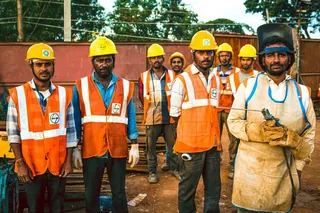
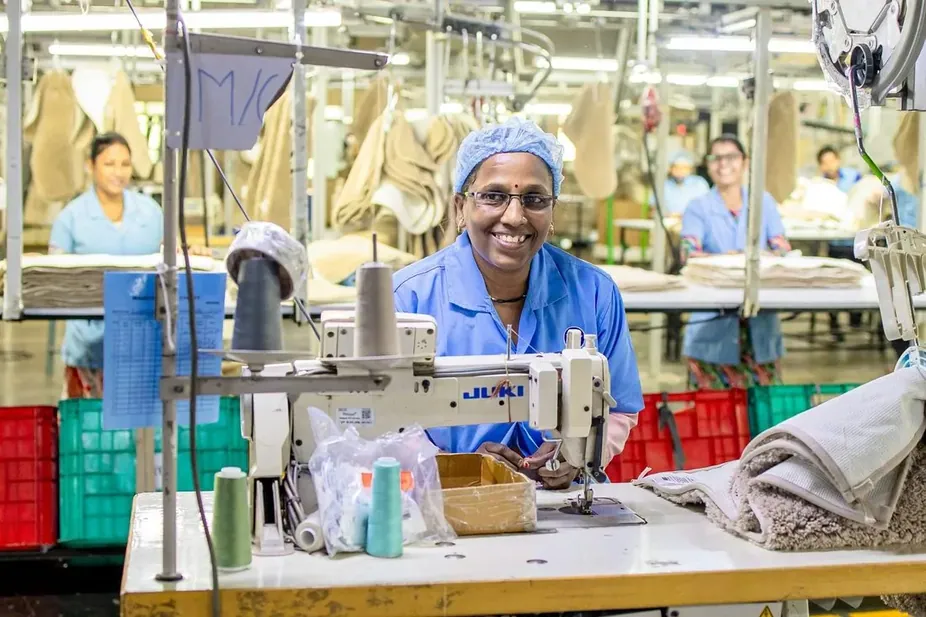
Map the jobs that exist and will exist where people live: by sector, district, wage and growth. Employers help decide what is taught, and how it is assessed.
Competencies an employer can observe, practice on the tools of the trade, apprenticeships and on-the-job learning, and AI fluency in the roles where work is changing fastest.
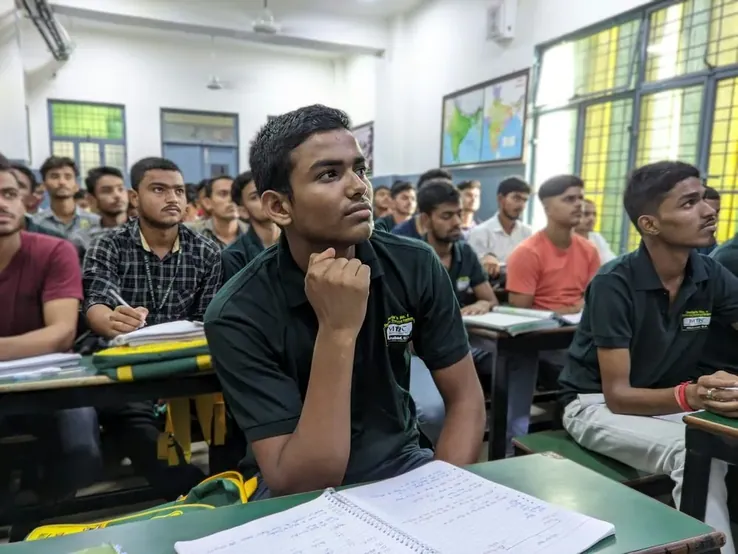
Guidance, information, introductions and help with travel, housing and the first month's costs, so opportunity does not depend on who you already know.

Skills-based profiles, verified evidence of work and AI matching, so a credential is not the only signal and employers look further than they usually would.

Check-ins, re-matching and support through the months when most people leave, with the employer as a partner in keeping them.
Retention, income and progression tracked for years on one shared record, so funders, governments and providers learn what works, and can pay for outcomes rather than activity.
No single training provider, employer or department can close the gap alone. What closes it is shared infrastructure: one record of the young person, open to everyone working on their behalf, and a common definition of success.
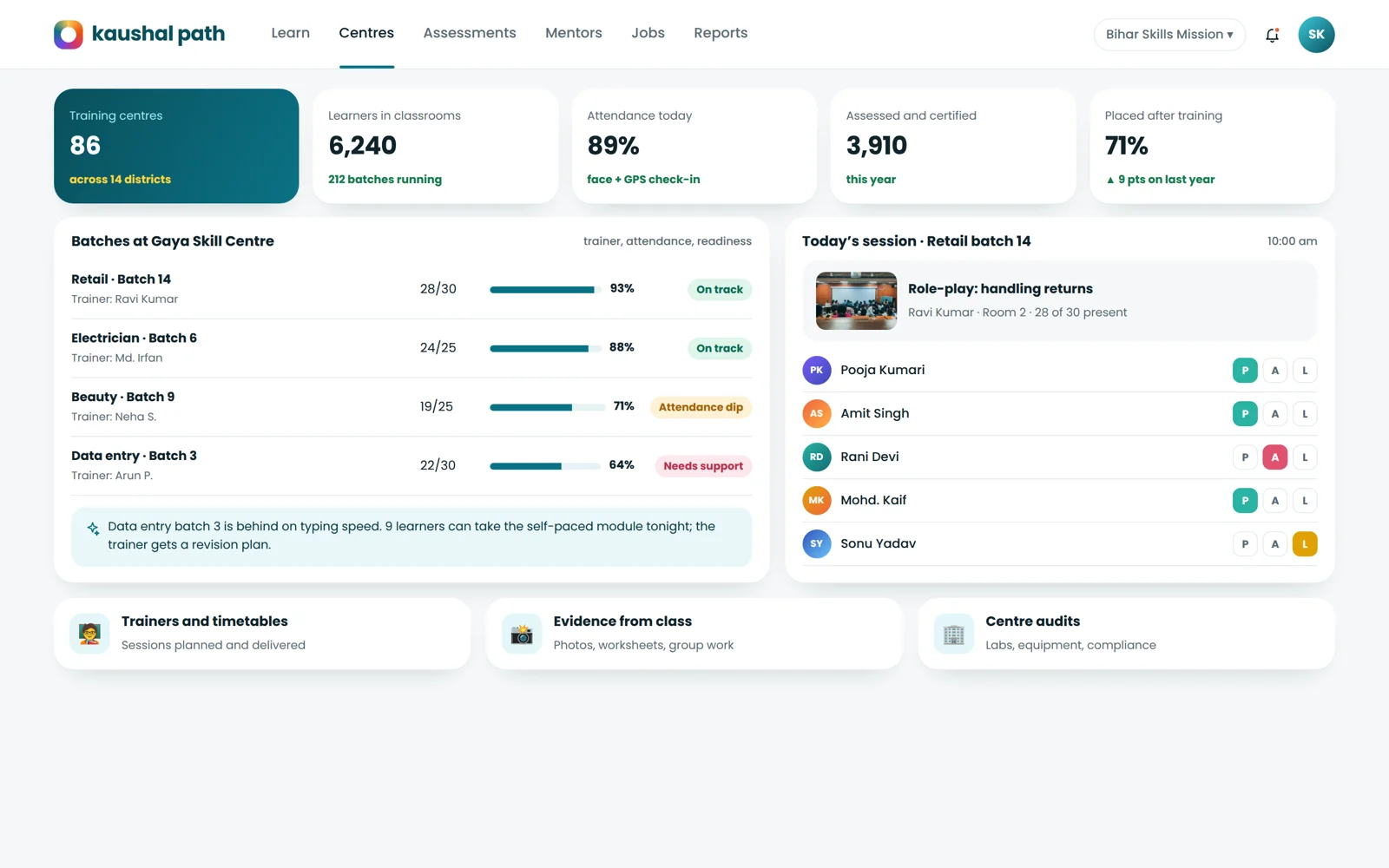
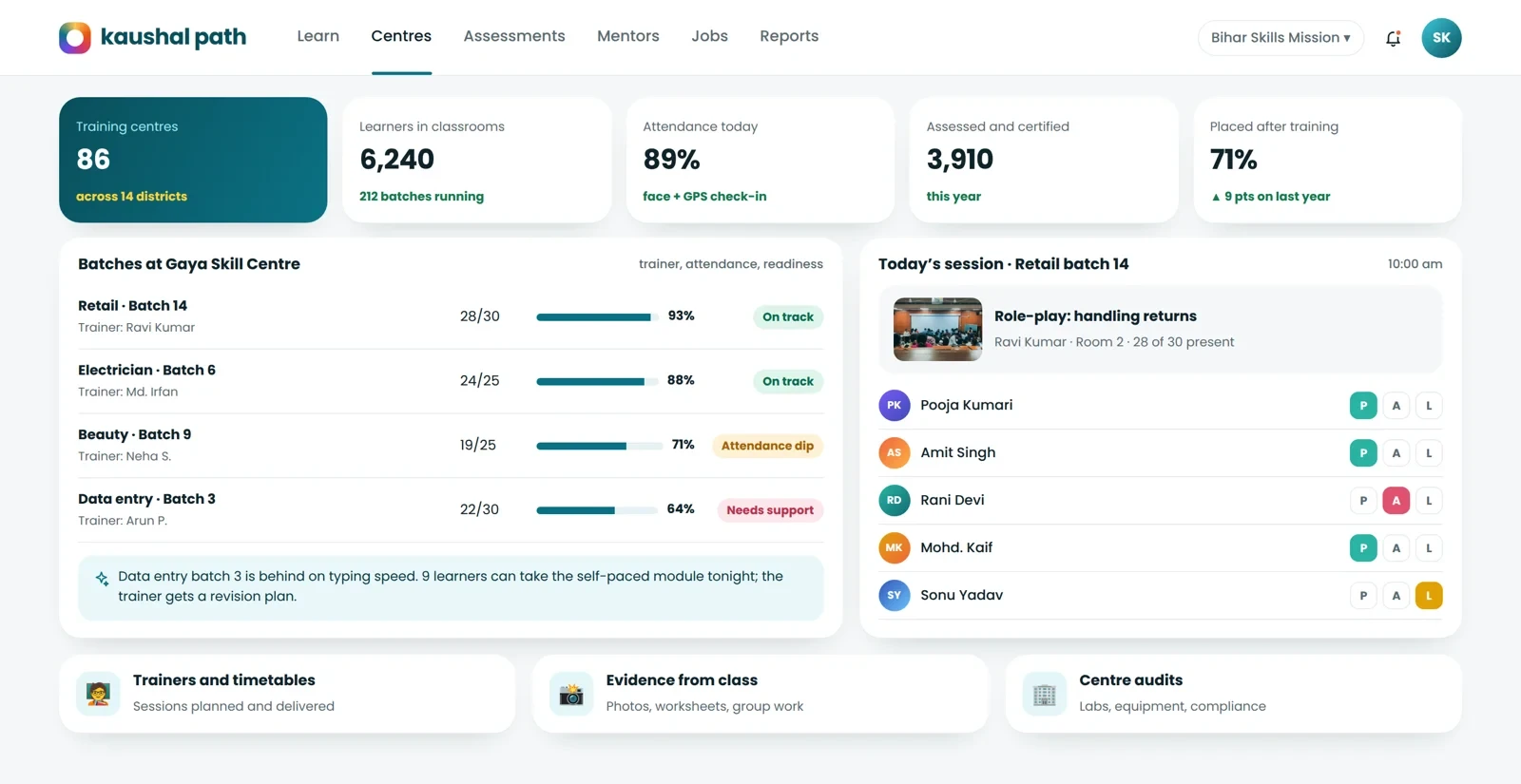
Run every centre for outcomes, not attendance. Mobilisation, batches, trainers, attendance, assessments, placement and what happens after placement, across every centre in a programme, on one record of each learner.
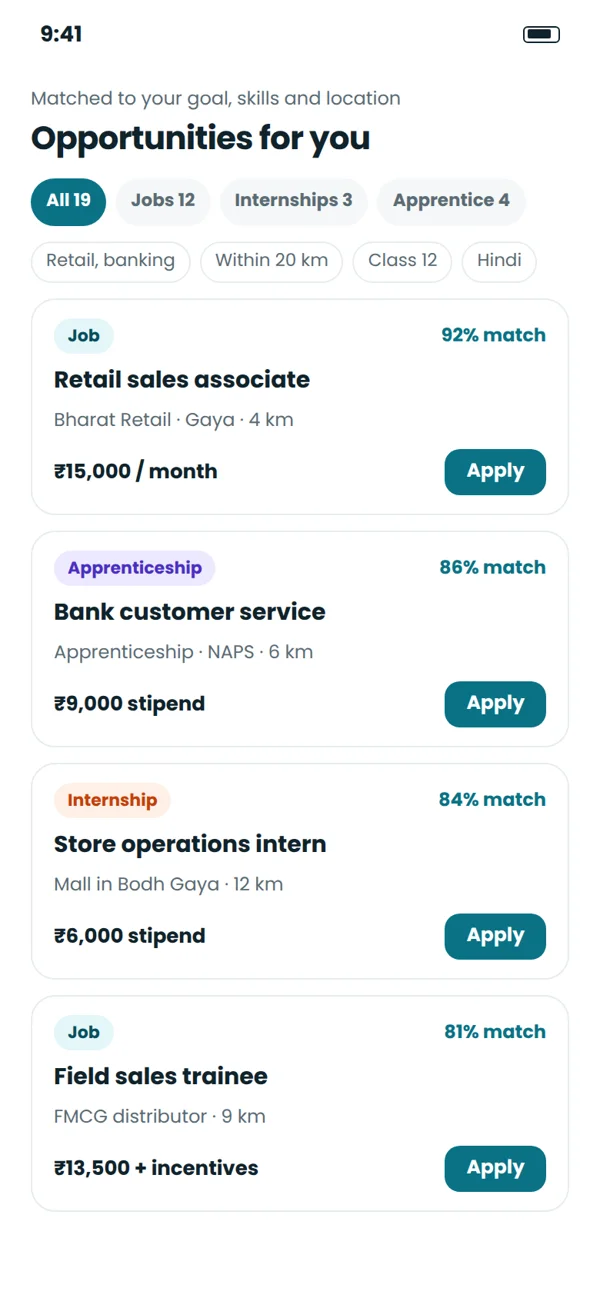
Jobs, apprenticeships and internships near where people live, matched on what candidates can do rather than only the marks they scored. Employers post once and reach every centre, college and programme on the network.
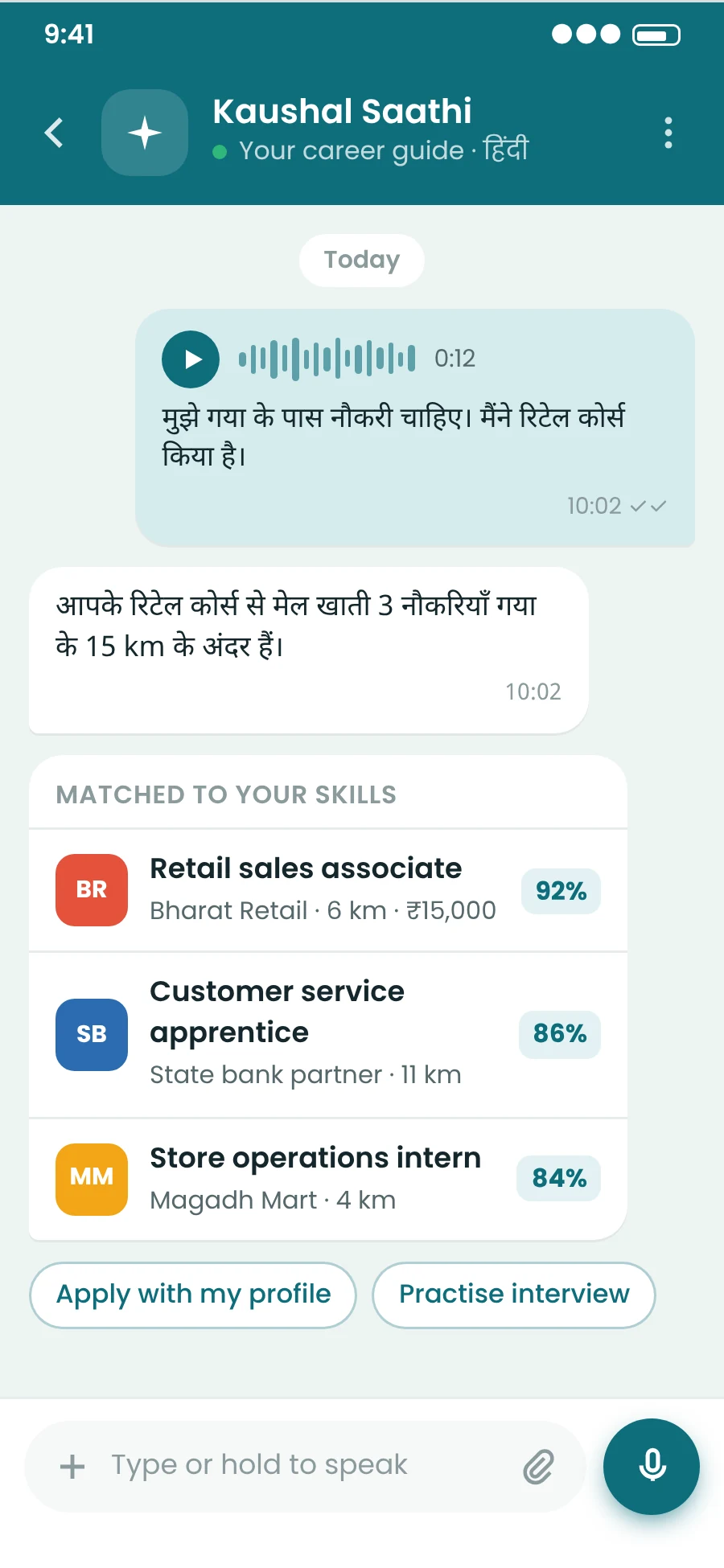
Three agents that do the busy work around a young person's first job, each on the same shared record. Each one listens as well as it reads, so a candidate can speak in their own language rather than type. For candidates: finds work nearby, explains it in their language, and practises the interview with them. For trainers: turns what employers reject into tomorrow's practice, and tracks who is ready for assessment. For employers: screens on skills rather than marks, books interviews, and reports back on who stayed.
Work is changing fastest in exactly the entry-level roles young people are trained for. This programme prepares them for the job as it is now, with AI in it, and is judged on whether they get that job and keep it.
 No poverty
 Quality education
 Gender equality
 Decent work and economic growth
 Reduced inequalities
 Partnerships for the goals
Young people looking for their first job.
The teams running batches every day.
Companies hiring at the entry level.

State and national skilling programmes.

Funders who want placement, not certificates.
“We do not start with a proposal. We start by understanding your problem well enough to deserve one. Bring it to us as it is, messy is fine, and we will figure out the way forward together.”

Cost per placement, not cost per certificate.
From mobilisation to 90-day retention, designed around the trainee.

Batches, assessments and employer matching in one system.
Opening, running and handing over centres.

A skill mission, a training partner, an employer or a funder: we will tell you which of the three problems we would start with, and what it would take.